• Published on

    2025: Stories & Strains

    This year has seen some big projects and big ideas become reality. It’s also seen new collaborations and plenty of opportunities for learning and evolution. But it’s also been a turbulent year globally, personally and professionally. Here’s a quick run down of where I’ve been focussing my energy, what’s been difficult and what I’ll take from this year into next. 


    The Projects

    One highlight was launching our bookScientists on Survival’, which coincided with touring the UK with screenings of the film Plan Z. Both the book and the film communicate the stories behind our actions as scientist-activists, sharing our personal responses rather than depending on facts, figures and graphs alone to convey the enormity and urgency of the crises facing life on Earth. 


    Having stepped away from research science last year, I’ve been re-engaging with the academic world via workshops, talks and panels at universities from Edinburgh to Exeter. These have drawn on many of the themes and ideas woven into the book and film, challenging different audiences with the question of how scientists respond effectively in, as the Global Tipping Points conference described it, “a post 1.5℃, post-truth era”. 


    In parallel, I’ve continued to explore the much less familiar grounds of corporate sustainability, primarily by working with AimHi Earth on updating and re-invigorating their training content. I’ve also taken on some paid campaigning roles for the first time, bringing scientific communication expertise to a range of grassroots and more professionalised organisations that aim to inform policy, activate people and empower communities. Fresh in my mind as I write this is perhaps the most consequential of those roles, collaborating and advising on the National Emergency Briefing on the climate and nature crisis. 


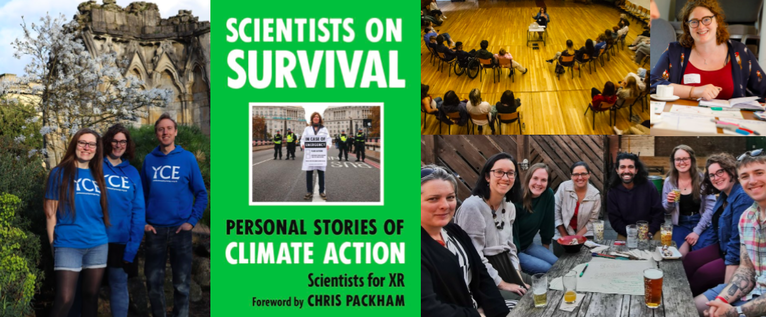
    Amidst all these different strands of work, one constant has been my Fridays with York Community Energy, where we have been gearing up to establish our first community-owned renewable energy projects in 2026. 
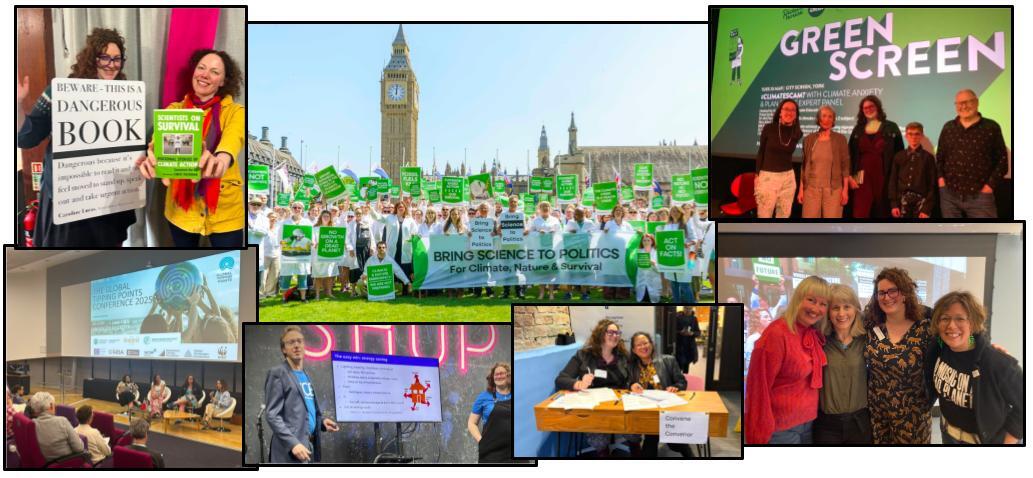
    Image description

    Want to know more? Some of this year’s major “outputs” include...

    🦠 A farewell to microbiology research, in our review Protists & Protistology in the Anthropocene. Latter sections summarise key messages, applicable across many disciplines. 


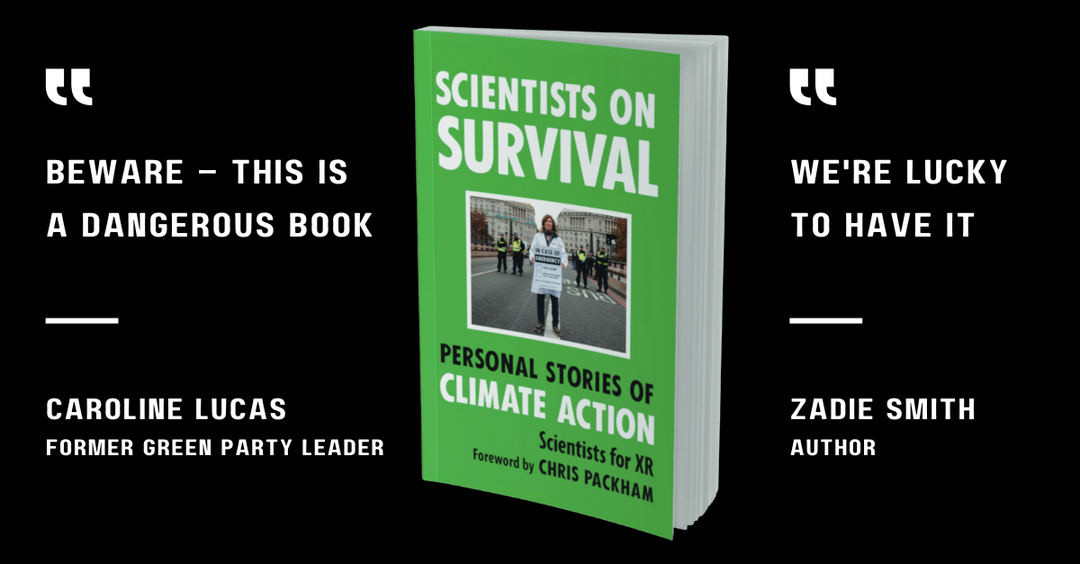
    📗 Scientists on Survival: Personal Stories of Climate Action, which is now available as an ebook and audiobook, as well as in print. 


    🏛️ Our new campaign to ‘Bring Science to Politics’. Updates to be posted here.


    🧪 Our research paper on how scientists can contribute to social movements and climate action.


    ⚠️ A first of its kind National Emergency Briefing. See coverage by Forbes, New Scientist and The Guardian, and recordings of the talks


    🪲 A series of community workshops and networking events in York.


    The Challenges

    Watch any news bulletin or your social media feed and you may well feel like I do - that hope is harder and harder to hold on to. Throughout this year especially I’ve struggled to make sense of a world that’s lurched further into denial instead of embracing transformations we know are needed for our own survival. And I’m terrified to see so much power in the hands of a dangerously self-serving or misguided few whilst freedoms, rights and safety are ripped away from pretty much everyone else. When we desperately need action, inspiration, compassion, community and solidarity, we’re getting yet more delay, deception, disillusionment, division and despair. Against this backdrop, it's no wonder that climate work has been more challenging than ever. These are some of the aspects I’ve been grappling with for the first time in 2025:


    1) Shifting demands. Last year (2024) most of my work was sharply focussed on delivering complex information about climate and Nature in clear, accessible, engaging and (hopefully!) motivating ways. I’ve written before about why this is still so vital to do: a necessary precursor to effective actions being taken. It’s also the niche where I feel I can apply my own skills and experience most effectively. However, I find demand for this kind of work evaporating, fast. Climate and Nature have plummeted down the political agenda, sustainability is no longer seen as a priority for most businesses, and drawing proportionate media attention to the most pressing issues of our existence? Like getting blood from a stone. Where doors have been left ajar rather than closed completely, I’ve felt under increasing pressure to “tell a nicer story” or to fast forward to recommending actions - usually simple, measurable, immediate, non-transformative actions - rather than facilitating the learning that would allow organisations and leaders to make well-informed decisions and deeper, systemic shifts that will ultimately benefit them (as well as everybody else!). 


    2) Precarity and power dynamics in freelance work. Without the protections of formal employment, nor the security of knowing you’ll be offered ongoing work, pushing back things like these shifting demands or raising any other concerns can feel difficult and dangerous… because it is. Being perceived as critical, negative, demanding, idealistic or emotional (all of which are something of an occupational hazard when you’re tasked with delivering uncomfortable information or campaigning for change) can end working relationships abruptly. Add to this that it’s easy, and perhaps convenient, to undervalue freelancers/contractors, with pay being just one salient aspect of this. Once you factor in all the costs, time and accountability clients pass on by not employing someone formally - think holiday and sickness allowances, pensions, insurance, equipment, software, workspace etc - paying a freelancer equivalent to an annual salary at UK living wage would mean offering a day rate of at least £300 - something that is incredibly rare to come across in climate communication.* I don’t know of anybody who does this kind of work for the money nor for an easy life - we do it because we care deeply about it. But as a consequence, I recognise I have accepted or tolerated conditions and behaviours that have undermined the foundations of my ability to do good work. This runs far deeper than the financial precarity I knew was a risk; I was not prepared for the impacts on my self-confidence, trust and safety in relationships, and physical & mental health. 

    * See (for example) the methodology, calculations and guidance from the Creators Rights Alliance Freelance Day Rate Guide. In 2025, I’ve worked two single days for rates higher than £250. For a variety of reasons almost half of the work I have done this year has ended up being unpaid.


    3) Generative AI. To summarise my personal resistance to embracing generative AI, I (legitimately!) fear that it’s enabling and turbocharging so many of our most destructive activities and behaviors. Naively, I hadn’t anticipated that my own work would be particularly impacted by it. But this year I have been surprised by how readily and how rapidly tools like chatGPT have been normalised, even within environmental communication and activism.* I have lost creative work to AI. I’m aware that my words have been fed to LLMs that have then been used to write like me… yet say things I wouldn’t. However ‘good’ AI models appear to be, they can’t reliably nor critically evaluate whether they’re serving up the best-available information, nor can they draw on the uniquely human experiences that allow you to carefully consider specific audiences and the nuances of what is (and isn’t) likely to resonate with them. Precisely because of how LLMs are built and trained, they’re extremely prone to reinforcing already-dominant ideas, which is a particular problem for anyone seeking to challenge those often-harmful norms and pave the way for us to create better ones together. It has felt surreal and quite demoralising to have had to advocate for the value that real humans bring to climate communication. I know that this will be something we will have to keep responding and rising to. 

    * I could accidentally turn this into a long dissection of the issues around generative AI and the specific harms I am most concerned about, but for now here are just some of the environmental and ethical reasons to bear in mind when considering using it. Also, to be clear it is not my intention to judge others for using it, especially in situations where I know there has been careful consideration of whether and how to do so.


    4) Communication and conflict in spaces where exhaustion, burnout and financial pressures are rife. I get to work closely with committed, caring, talented people, which is an enormous privilege and joy; almost all of my colleagues, collaborators and clients quickly become people I hold a lot of respect for, trust in and would consider friends. At the same time as being incredibly valuable, this raises the stakes when stresses or conflicts flare up. I've seen multiple once-positive relationships break down lately, some catastrophically, often without a clear reason. Where I’ve been directly involved or affected, it’s felt painful and confusing. My best explanation is that the strains of this work and of the times we live in are really starting to show themselves. The work we do can be distressing, enraging, unforgiving, isolating. Many of us have experienced repeated defeat and personal attacks in the course doing our (imperfect!) best in pursuit of a safer, fairer world… yet so many of us (myself absolutely included) have been slow to acknowledge and attend to the toll this takes. When worn-down people are trying to do difficult work together, it can create conditions for a ‘perfect storm’ (by which I mean an extremely crap storm): we place ourselves in intense, often stressful environments that demand we communicate clearly and that we take time to properly listen to and support one another… all whilst our capacity for either is compromised. Experiencing how this can play out has forced me to take stock and start to be more intentional about finding a sustainable balance between action, rest and recovery.


    The Learning

    It’s been a tough year. But without meaning to sound clichéd I’m grateful for all I’ve learned from it. A few things I will be taking forward with me are:

    • Choosing projects carefully, prioritising balance instead of pushing further beyond my limits, seeking and contributing to supportive working environments and relationships.  
    • Courage to advocate more assertively both for the value of my own work and for conditions that make continuing to do this work sustainable. 
    • Remembering the power in honesty and vulnerability. Communicating through personal stories, despite initially feeling intimidating, has unlocked better, kinder conversations with a broader range of people this year.


    Without meaning to sound even more clichéd I’m hugely thankful for all the people who have made this learning possible, for their wisdom, experience, support, care and love. This year I’d like to specifically acknowledge how much I’ve appreciated Caroline, Emma, Viola, Shana, Susi, Sophie, Jen, Lynn, Aaron, Rich, Kirsten, Sophia, Simon, Nick, Amy, Dom, Curly, Molly, Pete & Rob. 


    Signing off for 2025 🥼💚

  • Published on

    Balance vs Burnout

    I’ve often heard myself described as an all-or-nothing person.  I’m not sure how much I agree with that, but I’m certainly leaning into that description by doing what I’m about to do now…taking all of August off.  Properly off.  No work, no campaigning, no talks, no protests, no Zoom meetings. I’m not going on a big trip somewhere, I don’t have a big list of tasks to complete… 


    So why am I doing this, taking time off without a plan? Taking time off where there is SO MUCH that needs to be done? Well, basically, I fear the consequences if I don’t… stop. 


    I know I’m not the only person finding this year particularly intense or fraught or demoralising. Within the communities I’m part of I can see so many of us struggling with the weight of knowing and feeling the mounting threats of climate and ecological breakdown, especially whilst action to confront it has seemingly lost momentum. I see many struggling to bear that pain and feeling of powerlessness, amplified massively by the escalating authoritarianism, heartbreaking violence and continued repression of peaceful activism we’re witnessing. This didn’t begin in 2025 - it has been building for a long time - but I’ve felt a step change. 


    Highs and lows are an inevitable part of trying to drive change, of trying to do pretty much anything worthwhile. Since I first started engaging with the climate movement in 2018, the hard bits have been tempered, held and offset by the incredible friendships, networks and communities forged within them. Knowing we face many defeats we’ve got quite good at celebrating the wins, however small. Recognising we’re up against existential threats somehow makes it easier for us to properly appreciate the stuff that really matters, especially connection with other people and the all other life there is around us. For all the many moments of despair, I’ve enjoyed access to a steady stream of warmth, encouragement, laughter, cautious hope.  But that semblance of balance has been much harder to find; years of Emergency action are now showing their strain on us. 


    It can be tempting to dismiss rest as an indulgence we can’t afford. Logically, I know this doesn’t really hold up. Without rest, and without taking some care of our physical and mental health, how can we expect ourselves to be OK-enough to keep showing up? But taking a break can feel dangerous. It feels dangerous to me right now. It’s not that I think that the future of humanity, nor even of the projects close to my heart, hinges on my own immediate actions (or lack thereof) - that would be both arrogant and unrealistic. It’s hard to articulate, but I think it’s a combination of: fear that I’ll let people I love down; fear that - with all the privilege I have to be able to take action - I’m failing to fulfil a moral obligation to do as much as I possibly can; and something much more nebulous around my sense of self-worth and identity I might lose by not being fully and actively engaged in the work I’ve come see as essential.


    When I really try to interrogate this, I can see that not resting, not striving for a sustainable balance has been a bigger danger, and a consistent failure. That reality has been impossible to ignore this year. In January, a spell of what I described at the time as “full blown dread”*, would probably have been more wisely interpreted as a warning … rather than an inconvenience, weakness or challenge to push through. Had I done this, and then prioritised rest / recovery / ‘regen’ in response, I suspect that a lot of the exhaustion, errors, overreactions and damage to relationships that have punctuated the months since could and would have been avoided**. It’s time to move from berating myself for this, to learning from it. It’s time for a reset. For myself but also for the people around me… and for the work we still need to do together.

    Image description

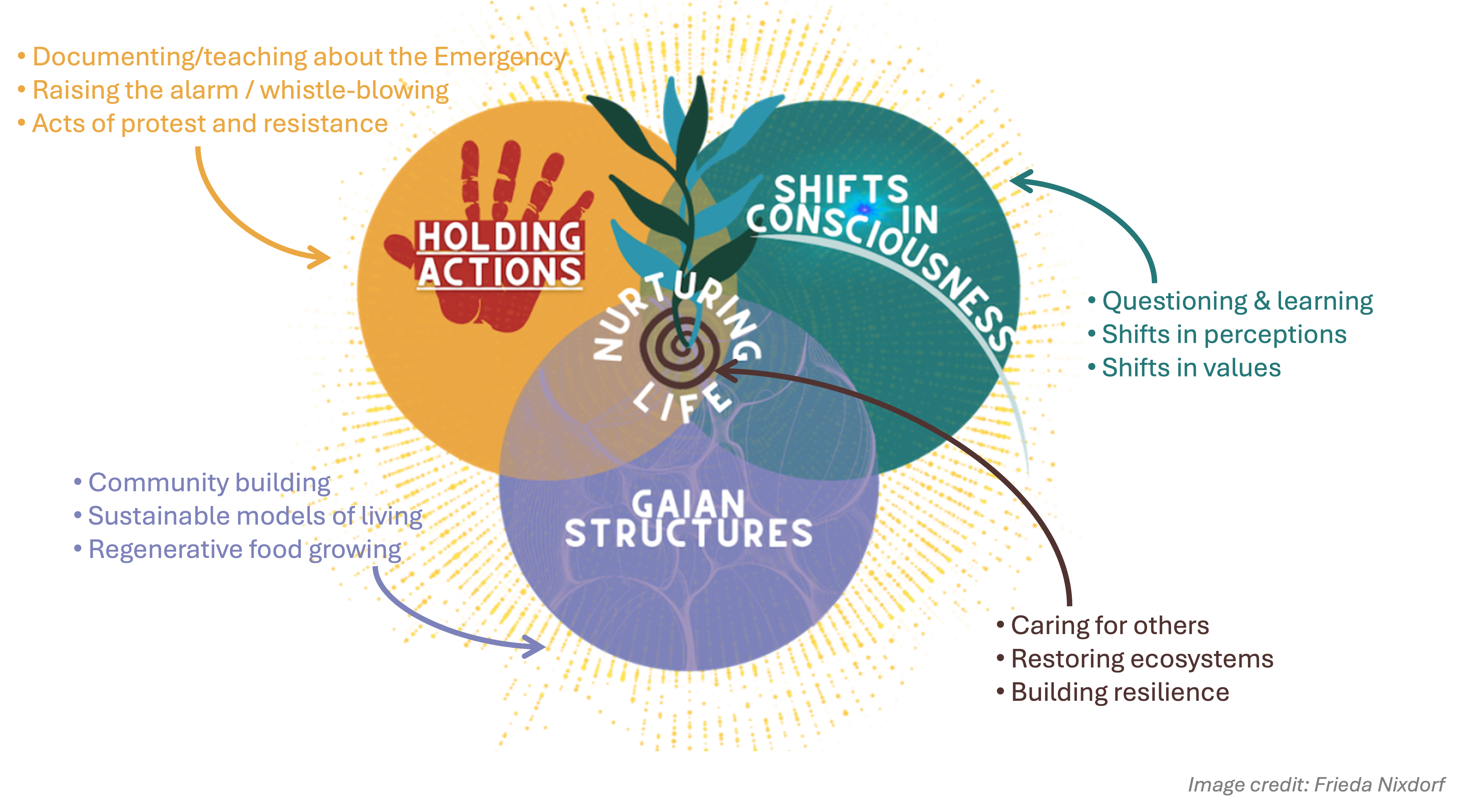
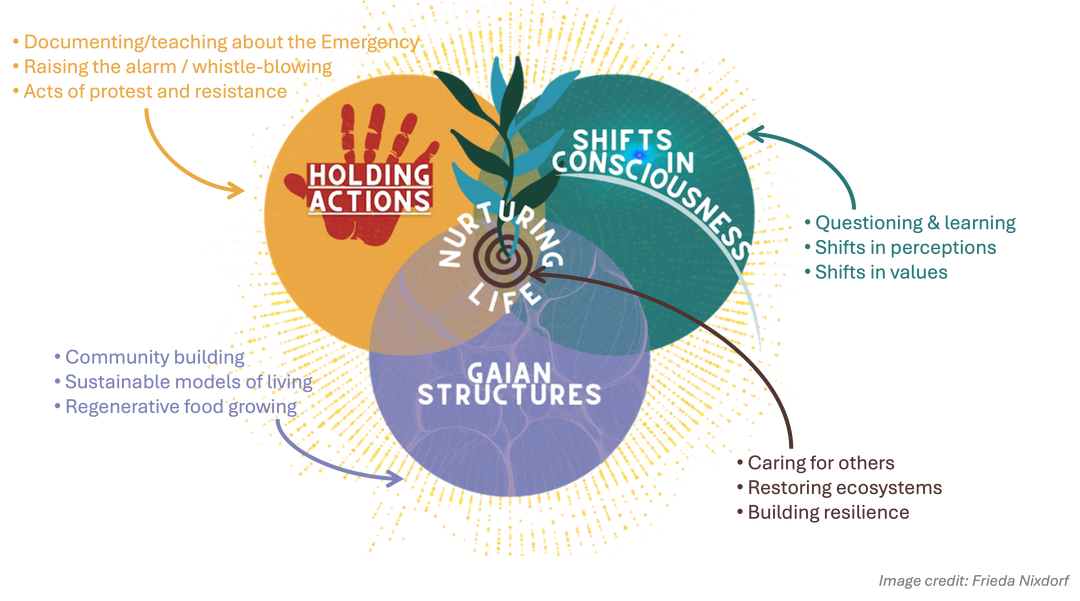
    Dimensions of the Great Turning from The Work that Reconnects, annotated with examples.


    Speaking of ‘the work’, I’ve been prompted recently to revisit thinking about exactly what that is. The focus of most of my attention and energies over the past seven years have been what can be described as “holding actions”: attempting to raise understanding and intervene to prevent avoidable harms. I desperately want more people, if not most people, to be empowered to take these kinds of actions too, because that means they’re more likely to succeed and that the personal risks for people who take a stand are massively reduced. When I was first introduced to the concept of there being multiple ‘dimensions’ to the work needed to bring about systemic societal and political transformations I found it strangely threatening. Maybe I perceived the other dimensions as avenues that could be used to justify “opting out” of the types of action I (still) feel very invested in. But gradually I’ve come to understand that these are necessary complements to, rather than competitors of, “holding actions”. I’ve realised that ‘activists’ can have a tendency to only “count” these often-exhausting types of action as ‘the work’; we don’t often acknowledge the constant learning, the radical shifts in our priorities, values and approaches, the care and community we cultivate. These are valid too - essential even - and absolutely worthy of our time, attention and celebration.


    In taking a break, these are thoughts and ideas I’ll probably have more space for. But if all I’ll end up doing is disrupting a pattern of imbalance and overwork, well, that’s not nothing.  Proper time with family and friends, getting outside and to wild spaces, decent-quality eating, moving and sleeping wouldn’t go amiss either.  


    See you in the Autumn 🧡


    * I wrote about this at the time here: https://abiperrin.com/dread-scale.html 

    ** Some personal positives amidst those negatives this year… for balance: we released our book, promoted a deeply personal film, coordinated a mass lobby in an attempt to bring science to politics; I’ve faced my anxieties around public speaking at universities, climate conferences and community events around the country; I’ve written and contributed to holistic, (hopefully) empowering climate and nature trainings for audiences who have real power to make a difference.


  • Published on

    The Power of Personal Stories

    How and why we wrote a climate book

    A personal story feels like the only appropriate form for this post.  This is the story of how I came to realise that it wasn’t just facts and evidence that were missing from our culture’s conversations about Climate and Nature… and of how coordinating and co-authoring the book Scientists on Survival: Personal Stories of Climate Action crystallised for me why the personal account has a remarkable power as part of those conversations.  
    For a long time I sincerely believed that showing the right science or the right evidence to the right people would inevitably lead to a cascade of events that would bring about the transformations that our species and societies desperately need.  The story I told myself was as follows. Equipped with the science, politicians would legislate to reduce the harm that humans have, mostly unwittingly, been causing, they’d throw support behind better, fairer, resilient and sustainable alternatives to the harmful systems of our age, they’d create an adaptation plan to help us cope with the consequences of the climate and ecological disruption that we can no longer prevent. Knowing the risks the climate and ecological breakdown pose to their own businesses - let alone the future of humanity - corporations would make a rapid pivot away from extraction and destruction and towards regeneration. Fuelled by knowledge, public consciousness and priorities would shift.  We’d demand that ‘leaders’ act with proportionate urgency, and enable us all to meet our basic needs whilst treading more lightly on the Earth we depend on for our survival. But, gradually, I’ve found myself forced to reexamine this simplistic ideal that was motivating my work in science (be that via engaging with research, communication, education or policy). Whilst maintaining that it is fundamentally important that we are well-informed, the combination of disinterested, dismissive and disempowered  responses to evidence I’d brought to different spaces over the years has made it clear to me that knowledge alone is not enough.  For each of us to take on our respective role in the tale I had been telling myself we’d also need an emotional connection to that knowledge - we’d need to feel the myriad ways it really, really matters to us.* We’d also need to believe that it is possible for our personal actions to make a difference. 

    Just over a year ago, a group of activist scientists were approached by a publisher, who invited them to write a book about the science of the Climate & Ecological Emergency. But the book that actually got written is not that book.** It’s not a ‘science’ book. Instead it’s a collection of personal accounts from scientists who’ve decided they need to do more than publish facts to play their part in protecting life.  When I heard the call for scientists to get involved, I was ready and willing to get stuck in… and it turned out to be a huge privilege to get to coordinate the project alongside the excellent Drs Caroline Vincent and Viola Ross-Smith, and to write it in collaboration with 21 other inspiring scientists, similarly motivated by our love for the world around us. 
    Scientists tend to feel relatively comfortable talking in data, statistics, probabilities, hypotheses and theorems … but what we’re rarely expected or trained to do is to communicate the emotional as well as the ‘rational’ responses we have when faced with information and its implications. I often wonder whether this has contributed to pervasive complacency about unfolding Emergency - by calmly analysing and documenting the breakdown of the Earth’s life-enabling systems rather than allowing ourselves to feel and show a commensurate level of fear, have scientists sent mixed signals about the scale and urgency of the crisis? It’s something I’ve actively tried to “unlearn” over the past few years: in most circumstances I have to consciously decide not to say something like “the E.U. Copernicus Climate Change Service data puts the average surface temperature of the Earth in 2024 at approximately 1.6°C above an estimate of the 1850-1900 temperature designated to be the pre-industrial level”, because what most people really need to know is that humans have heated the world beyond the point that scientists agree is safe for any of us. We can communicate clearly and urgently without compromising the integrity and accuracy of the scientific information, and I’ve come to believe that we scientists would be much more effective advocates for informed, positive change if we gave ourselves more permission to share how that information impacts us and what action it compels. Might we be in a better position now if decades ago many more scientists hadn’t stopped after “The Earth is heating rapidly” and instead went on to explain “This terrifies me and I am going to do everything in my power to stop us burning fossil fuels”?

    For Scientists on Survival: Personal Stories of Climate Action we encouraged and supported one another to speak from the heart rather than be constrained by a sense that scientists ought somehow to be detached, ‘neutral’ or dispassionate observers of a world in crisis. The process of writing our personal stories - whether about our journeys in science, transitions we have made, or protests actions we’ve taken - was different for every author.  Some chapters published today are virtually unchanged since they were first submitted to us, whilst others are radically different.  For me the most rewarding part of the whole project has been working with the authors to craft their stories into a clear, engaging and compelling narrative without detracting from each scientist's unique personality, humanity and voice (nor, of course, from the accuracy of any science they were communicating along the way). It has felt like such a privilege to get to know the humans behind those stories through doing this. Having spent years exploring how to communicate in ways that cultivate Emergency understanding and action, it’s also heartening to have tangibly supported people I find so inspiring to do the same. 

    As I write this on the book’s official publication date, I feel a rare sense of pride having contributed to showing the humans behind the protests and the headlines in this way. Amidst the stories told by those 24 people, there will be something liable to strike a chord with any of us trying to navigate life on this imperilled blue dot, whether we consider ourself to be a scientist, activist, both or neither. That makes me hopeful that our book can encourage and provoke its readers to envisage and embark upon a pathway to taking part in effective action (in whatever form makes the most sense for them). Watering those seeds of hope are incoming reactions from friends and family and activist acquaintances who got hold of some of the first copies.  Unexpected people have expressed admiration for the courage and passion the scientist authors have demonstrated.  They’ve shared a range of emotions, thoughts and questions evoked by these stories.  They’ve told me they feel moved and motivated to take - or at least investigate - various forms of action themselves. 

    *See my previous post “The Understanding Gap” for more thoughts on how both knowing and feeling are vital precursors for informed and effective action. 
    ** The story of how that happened, in the words of its co-author and co-coordinator Dr Caroline Vincent, is here

    More information about Scientists on Survival: Personal Stories of Climate Action

    As described by the publisher: "In this important and timely book, scientists from a broad range of disciplines detail their personal responses to climate change and the ecological crises that led them to form Scientists for XR and work tirelessly within it. Whether their inspiration comes from education or activism, family ties or the work environment, the scientists writing here record what drives them, what non-violent direct action looks like to them, what led them to become interested in the environmental crisis that threatens us all and what they see as the future of life on Earth.” 

    • If you’d like to read our book it’s now available in bookshops and online book retailers. We recommend Bookshop.org which supports independent retailers).  If the cost is a barrier to you please use my contact form to request a copy (I have access to a limited supply). 
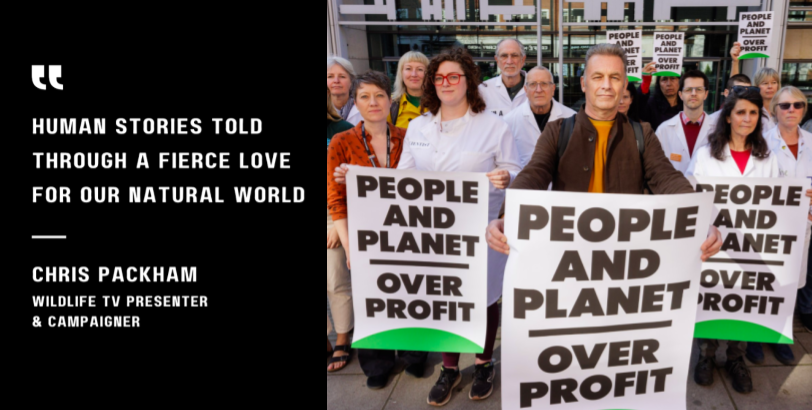
    • You can find endorsements from Zadie Smith, Caroline Lucas, Robin Ince, Sir David King, Prof Kevin Anderson and more here, and there are some early reviews already out from Brian McHugh and Tom Hardy in The Ecologist
    • A public launch event for Scientists on Survival is being hosted in York on Earth Day, Tuesday 22nd April. You can reserve a place via this event page.
  • Published on

    2024: A New Chapter

    2024 has been the start of a new way of working for this scientist.

    Transitions & New Experiments

    By the end of 2023, I knew the time had come to close the academic research chapter of my working life.  For many years I had genuinely believed that generating knowledge was the best way I could contribute positively to a sustainable future…but over time I’ve realised it’s not a lack of available knowledge that’s blocking that path; broadly we already have the essential scientific information - what we urgently need is for those essentials to be widely known and acted upon. 

    So, whilst wrapping up my research work (planting some seeds for change along the way), I set myself up as a freelance scientist open to any and all forms of climate and nature communication. By early February, my first ‘bookings’ were trickling in. My first was to run an interactive introduction to climate and nature science as part of a training day for Yorkshire’s NHS clinical psychologists. Subsequent highlights have included a keynote speech for environmental masters’ program graduates, workshops for various faith organisations, speaking as a panellist at several environmental documentary film screenings, and facilitating a discussion with an author and TV presenter about their recent book

    On the very same day as my first freelance ‘gig’ I started a part-time position with the renewables team at York Community Energy. My job involves working with local organisations such as libraries, sports centres and health centres to determine whether they’d be suitable locations for community-owned renewable energy infrastructure. Over the next year or so we’re looking to install a number of solar panel arrays and use the income from the energy we supply to support people in York who are most disadvantaged by our energy system through measures such as energy advice, home insulation and debt reduction (all whilst also contributing to the decarbonisation of our city’s energy supply). My Fridays are now spent with the rest of the team creating models, refining plans, reporting and communicating our insights from our small office, else we’re out cycling to visit our sites around York, often catching some impressive views from the rooftops.

    I was delighted to accept a new opportunity last Spring, a contractor role as a researcher and writer for AimHi Earth.  For a time a few years back when I was learning everything I could about the climate and nature crisis, I took part in multiple sustainability training programmes and AimHi Earth’s stood out as by far the most holistic, engaging and motivating; it was a communication approach I was excited by at the time and am even more enthusiastic about now I’m involved with updating, refining, expanding and tailoring their training materials. Since joining the team, my role and responsibilities within it have grown significantly, my main focus now being a comprehensive refresh of the core training content that will be used to activate millions of nature-first thinkers around the world. 

    Perhaps the most surprising project I’ve been involved with this year has been the creation of a non-fiction book: a collection of short personal essays from scientists who have become activists. Alongside writing my own story and the book’s introduction, I’ve been part of its coordinating team and have had the privilege of working with other chapter authors to tell their unique stories in compelling, and sometimes emotionally vulnerable, ways (something that often doesn't come naturally to us scientists). The writing is now complete and Scientists on Survival: Personal Stories of Climate Action is due for publication in March. 

    Alongside this evolving portfolio of roles and projects, I’ve continued to channel energy into our flourishing local environmental network YorkCliConnect, created and shared a range of resources, and supported various campaigns and change-making organisations.  It’s been a particularly big year of action for Nature restoration, clean water and the Climate and Nature bill, as well as for challenging practices in the fossil fuel, biomass and insurance industries that are exacerbating the threats to life on Earth. 

    Feelings & Learnings

    Leaving the lab behind came with some feelings of sadness and loss, and it was nerve-wracking to take a leap to a very different way of working… but thanks to the incredibly heartening support I have had and to the people and organisations who’ve chosen to work with me, it’s been an overwhelmingly positive and rewarding transition. In the work I do now I’m finding it much easier to see impact and progress within a more tangible timeframe.  I’m being invited into spaces where there’s an appetite for change and I have the chance to help it grow. I feel valued and trusted by the teams I now work within, as well as by the people I interact with more transiently in the course of my freelance work. Some adjustments have been more difficult: adapting to a lot of remote work and a lack of routine hasn’t been seamless, and perhaps because my work feels more impactful and purpose-driven, it’s been harder to find balance. But with experience and the guidance of the community around me, I’m (gradually!) learning to recognise and avoid patterns of overwork and exhaustion. 

    Alongside learning to work in different ways, my experiences in 2024 have really helped me develop confidence and competence as a writer, speaker and freelancer. In particular, the process of tailoring approaches and messages to better engage specific audiences has become more intuitive, and I’ve also come to appreciate the surprising power of the personal story (I intend to write more about this!). More than ever before, I’ve seen the enabling and supportive strengths of community; my friends, partner and activist family provided me so much encouragement as well as practical support to make this transition, and an even bigger network has made that transition a success. To name just a few of those contributors specifically, I’m hugely grateful to: Matthew, George and the wider team at AimHi Earth; my community energy colleagues Rich and Kirsten; fellow book coordinators Caroline and Viola and all the other scientists who have contributed to this project and the wider movement; everyone involved in environmental campaigning and activism  - it’s been a particularly tough year but there’s been a lot to be proud of; last but not least Caroline, Sophia, Zoe, Curly and Dom whose care and wisdom has meant more than I can articulate.

    Going forwards

    Much of the work I started this year will continue into 2025, but in order to work more sustainably and impactfully I’m making a commitment here to refine what I focus on.  Previously I’d intended to reach as many people as possible but now I’ll aim to prioritise bringing the most essential climate and nature science to those with the most power – and therefore responsibility – to accelerate necessary system change. In practice this means a shift in my community-based roles to focus less on delivering training, instead supporting others to gain confidence in doing so. It also means spending more time and energy engaging groups I’m currently less familiar with or comfortable within, specifically in corporate and political spaces. 

    I’m looking forward to sharing our book, to seeing the impact of our new and refreshed training course, and overall to helping nurture understanding of climate and nature science in ways that grow our collective ability to act and adapt in a rapidly changing world. 

  • Published on

    Always A Scientist

    Personal reflections at the end of a 15 year chapter in academic research science.
    ‘Scientist’ is usually the first word I use to describe myself, and that's probably because throughout my adulthood ‘scientist’ has been not only my job but something of an identity. Hence my exit from academic research this year has felt like a massive transition personally as well as professionally. But as much of a wrench as it has been to leave the lab bench behind me, the data, the evidence, my head and my heart are aligned on this one: in an era that will be defined by how we respond to compounding existential threats, it’s time to find a new way of being a scientist.

    Once a scientist...

    Scientific research can be such an incredible job to get to do. You’re tasked with observing, investigating and documenting a slice of the as-yet-unknown. You could well be the first – or even the only – person to witness or understand something amazing about the fabric of our world. It was surprisingly easy to lose that sense of wonder whilst immersed in competitive pursuit of the data, publications, funding and accolades that make it possible to keep climbing the career ladder in academia. But now, outside of that environment, I’m grateful to be able to look back with fondness on the tens of thousands of hours I spent planning experiments, tending to colourful flasks of assorted microbes, peering down increasingly fancy microscopes, developing those dreaded Western blots, then processing, analysing and sharing the insights this all generated. I’d really thought that my life in science would stay something like this until a comfortable retirement sometime in the 2060s. But about half a century ahead of schedule, its course started to look very different.  
    As a researcher studying malaria parasites and later similar types of environmentally-important ocean microbes, I’d felt motivated by the idea that we were making a meaningful contribution to improving lives and preventing suffering. But, catalysed by growing public concern about climate change in 2018, I’d found myself conflicted about the narrative that my research career was a noble pursuit, or something that would ultimately benefit humanity.  I’d started to ‘zoom out’ and see the wider context I was working within: one where thousands of scientists had clearly identified imminent, existential threats; one where transforming our societies is the only way to prevent their collapse… but where we’re still struggling to translate knowledge into the action needed to protect life on Earth. 

    Despite wide acknowledgement of the climate and ecological emergency, and despite rhetoric around environmental sustainability, very little about the culture and daily experience of working in research science was changing around me. It was an uncomfortable paradox that I felt badly equipped to navigate - the new ‘normal’ was, on the surface of it, to accept that we’re facing crises that will profoundly change our lives… whilst simultaneously continuing with our work pretty much unchanged by that knowledge (though perhaps paying a bit more attention to plastic recycling). I found this confusing, especially amongst the research community, who I’d assumed to be in a prime position to understand and respond to what the science was telling us. In their article No research on a dead planet my friend Dr Aaron Thierry and co-authors explore why this ‘double reality’ currently prevails: none of us are immune to powerful psychological incentives to minimise or suppress our knowledge and feelings about frightening information, but – vitally – we each do have agency and opportunity to overcome these barriers and start to play a role in creating necessary, transformative change in our systems, institutions and societies. 

    For me it was feelings of fear, despair and isolation – not of duty nor agency – that first led me to find community as part of environmental social movements. I was especially drawn to spaces where scientists were organising, and all I’ve learned there has evolved my perception of what a scientist’s role could or should be in the 21st century (summarised here and potentially the subject of a future blog post). It empowered me to be braver, to explore how a scientist can make a positive impact within and beyond their job. So, alongside making various transitions in my lifestyle and research direction, I began, initially tentatively, to talk much more openly about the disruption of Earth’s life-supporting systems, my fears and feelings about what that meant for us, and my experiences of taking action in response.  At work I attempted to start conversations about how academics might support and accelerate positive transformations, to activate people in leadership positions, to push for accessible and impactful environmental education and to build networks. Beyond the lab, I found many other avenues where a science background together with experience in advocacy and activism could be usefully combined; from facilitating workshops in my local community to amplifying scientists’ warnings through campaigning and direct action.

    ... always a scientist?

    Overall I’ve been very fortunate to have had a positive experience in moving from knowing about to acting upon the climate and ecological emergency.  The reactions of colleagues, friends, family and the wider public along the way have largely been encouraging and motivating,  though there have been challenging complexities, tensions and occasional hostility. Amongst the more painful have been in recognising and attempting to counter the inertia that persists within academia – a home I had, maybe naively, thought I’d be effectively-placed to help activate from within. Like many scientists I’ve had the pleasure of interacting with (including the authors of these calls-to-action), I still believe in the potential of the scientific research community, and of universities in particular, to foster and adapt to rapid change in our environment and societies.  However, my own attempts to cultivate engagement and action have felt much less constrained – and ultimately more effective – where I’ve been working outside of any academic role, instead acting as a scientist in wider society. 
    The work I now prioritise focuses on exactly that; bringing the most essential science out of academic silos and into the places it needs to be understood and acted upon. In 2024, those included public and community spaces, local and national government, and, via an innovative educational start-up, some of the world’s biggest corporations. I don’t feel any less a ‘scientist’ having made a leap out of the research spaces that had become comfortably familiar.  I’m still discovering, learning, experimenting, analysing and communicating, only now I use different methods in different environments to better align my actions with addressing broader, more urgent questions and challenges. I miss the lab, the students, the microbes and the associated moments of awe that were part of my life as a more traditional academic scientist, but I’m excited by the opportunities and impact that are already part of this new chapter.